How Small Businesses Can Use AI to Grow Faster
R
Artificial intelligence (AI) is no longer a technology reserved for large corporations with massive budgets. Today, small businesses around the world are increasingly adopting AI-powered tools to improve efficiency, reduce costs, enhance customer experiences, and drive growth. Thanks to affordable software and user-friendly platforms, AI has become accessible to businesses of all sizes.
For small business owners facing limited resources and growing competition, AI offers practical solutions that can automate routine tasks, improve decision-making, and create new opportunities for success. As AI technology continues to evolve, understanding how to use it effectively can provide a significant competitive advantage.
Why AI Matters for Small Businesses
Small businesses often operate with limited staff, tight budgets, and multiple responsibilities competing for attention. Business owners frequently manage marketing, customer service, operations, finances, and sales simultaneously.
Artificial intelligence helps solve these challenges by automating repetitive tasks and providing valuable insights that would otherwise require significant time and effort. Instead of replacing employees, AI enables teams to work more efficiently and focus on higher-value activities.
By leveraging AI strategically, small businesses can improve productivity, increase profitability, and deliver better customer experiences without dramatically increasing costs.
Improving Customer Service
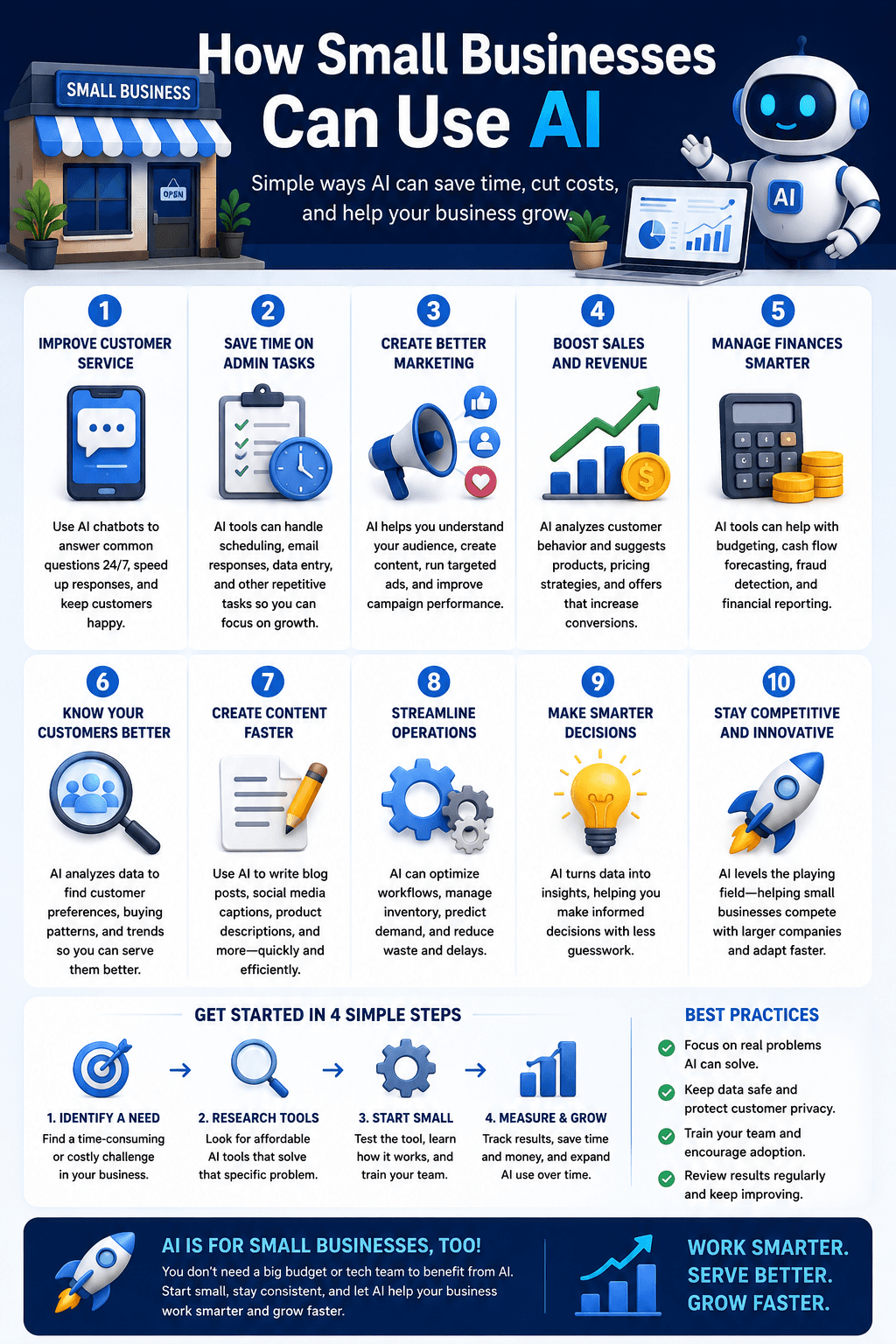
One of the most popular applications of AI for small businesses is customer service. AI-powered chatbots can answer common customer questions instantly, providing support 24 hours a day.
Customers often want quick responses regarding product information, pricing, shipping details, appointment scheduling, and business hours. AI chatbots can handle these requests efficiently, reducing response times and improving satisfaction.
When more complex issues arise, the chatbot can transfer customers to human representatives. This approach allows businesses to provide consistent support while reducing the workload on customer service teams.
Improved customer experiences often lead to stronger customer loyalty and increased sales.
Automating Administrative Tasks
Administrative work can consume a significant amount of time for small business owners. Scheduling appointments, managing emails, organizing documents, and handling data entry can reduce the time available for strategic growth activities.
AI tools can automate many of these repetitive processes. Intelligent scheduling assistants can coordinate meetings, send reminders, and manage calendars automatically.
Email management systems can sort messages, prioritize important communications, and generate responses for common inquiries. Document processing tools can organize files and extract information from forms quickly and accurately.
Automation allows business owners and employees to focus on activities that directly contribute to growth and customer satisfaction.
Creating Better Marketing Campaigns
Marketing is essential for business growth, but creating effective campaigns can be time-consuming and expensive. AI-powered marketing tools help small businesses develop more targeted and efficient strategies.
Artificial intelligence can analyze customer behavior, identify audience preferences, and recommend personalized marketing approaches. Businesses can use AI to create social media content, write email campaigns, generate blog topics, and optimize advertising performance.
AI can also help determine the best times to post content, identify trending topics, and monitor campaign results. These insights enable businesses to reach the right audience with the right message.
By improving marketing efficiency, small businesses can maximize their return on investment while expanding brand visibility.
Increasing Sales Opportunities
AI can help businesses identify sales opportunities that might otherwise go unnoticed. Customer data analysis allows businesses to understand buying patterns, preferences, and behaviors more effectively.
AI-powered recommendation systems can suggest relevant products or services to customers based on previous purchases and browsing activity. Personalized recommendations often lead to higher conversion rates and increased revenue.
Sales teams can use AI tools to prioritize leads, predict customer needs, and improve follow-up strategies. This helps businesses focus their efforts on the most promising opportunities.
As a result, companies can strengthen customer relationships while improving sales performance.
Managing Finances More Effectively
Financial management is a critical responsibility for every business owner. AI-powered financial tools can simplify budgeting, forecasting, bookkeeping, and expense tracking.
These systems analyze financial data and generate reports that help business owners understand cash flow, profitability, and spending trends. AI can also identify unusual transactions and assist with fraud detection.
Forecasting tools provide insights into future revenue and expenses, helping businesses make informed financial decisions. Better financial visibility allows owners to allocate resources more effectively and plan for growth.
By reducing manual accounting work, AI can improve accuracy while saving valuable time.
Understanding Customers Better
Successful businesses understand their customers' needs and preferences. Artificial intelligence can help analyze customer interactions, purchasing patterns, feedback, and online behavior.
This information provides valuable insights into what customers want, how they make purchasing decisions, and which products or services generate the most interest.
Businesses can use these insights to improve products, enhance customer experiences, and develop more effective marketing strategies.
Understanding customer behavior allows companies to build stronger relationships and create solutions that better meet market demand.
Creating Content Faster
Content creation plays an important role in digital marketing, but producing high-quality content consistently can be challenging for small teams.
AI-powered content tools help generate blog outlines, social media captions, product descriptions, email drafts, and marketing ideas. These tools accelerate the content creation process while maintaining consistency.
Business owners can use AI as a creative assistant to brainstorm ideas, improve writing quality, and optimize content for search engines.
Although human oversight remains important, AI can significantly reduce the time required to produce engaging content.
Streamlining Business Operations
Operational efficiency directly impacts profitability. AI helps businesses identify inefficiencies, optimize workflows, and improve resource allocation.
Inventory management systems powered by AI can predict demand, reduce stock shortages, and prevent overstocking. Businesses can maintain optimal inventory levels while minimizing waste.
AI can also support supply chain management by identifying potential disruptions and recommending solutions. These capabilities help organizations operate more smoothly and respond quickly to changing market conditions.
Greater efficiency often translates into lower costs and improved customer satisfaction.
Supporting Smarter Decision-Making
Every business decision involves some degree of uncertainty. AI helps reduce guesswork by analyzing data and providing actionable insights.
Business owners can use AI-generated reports to evaluate performance, identify trends, and forecast future outcomes. Whether making marketing, hiring, pricing, or expansion decisions, access to reliable information improves confidence and accuracy.
Rather than relying solely on intuition, businesses can combine human judgment with data-driven insights to make better strategic choices.
This balanced approach often leads to stronger business performance over time.
Getting Started with AI
Adopting AI does not require a large investment or advanced technical expertise. Small businesses can start by identifying specific challenges that consume significant time or resources.
Examples include customer support, marketing, scheduling, content creation, bookkeeping, or inventory management. Once a priority area is identified, businesses can explore affordable AI tools designed to address those needs.
Starting with one or two applications allows organizations to learn how AI works while measuring results. As confidence grows, additional AI solutions can be implemented gradually.
Training employees and establishing clear objectives can help ensure successful adoption.
Looking Ahead
Artificial intelligence is transforming the way businesses operate, and small businesses have much to gain from its adoption. By improving customer service, automating routine tasks, enhancing marketing efforts, supporting financial management, and streamlining operations, AI offers practical solutions for growth and efficiency.
The most successful small businesses will be those that embrace innovation while maintaining a strong focus on customer needs. AI is not about replacing human creativity or expertise—it is about empowering business owners and employees to work smarter and achieve better results.
As AI technology becomes increasingly accessible, small businesses that adopt these tools strategically will be well-positioned to compete, grow, and thrive in an increasingly digital economy.
| Category | Details |
|---|---|
| Topic | AI |
| Author | Rose |
| Published | 19/06/2026 |
| Read Time | Not set |
R